
Seminar Modular Product Platforms – Designing scalable and modular produkt architectures efficiently
The aim of modularisation and modular design is to achieve a high level of external customer diversity with a low level of component diversity. To this end, this seminar develops a modular concept in the following steps:
- Market and customer analysis
- Product and process analysis
- Definition of standards and variant diversity
- Development of the configuration logic
- Organisational anchoring
- Control of the modular system
Further information
Agenda
| Time | Programme item |
|---|---|
| 9:00 | Introduction |
| 9:30 | Fundamentals of Complexity Management |
| 10:00 | First step: Analyzing the market and portfolio to manage external diversity |
| 10:45 | Coffee Break |
| 11:00 | Second step: Structuring products to manage internal diversity |
| 11:45 | Third step: Defining standards for modular product platforms |
| 12:30 | Workshop: Market and product analysis |
| 13:00 | End of day 1 |
| Time | Programme item |
|---|---|
| 9:00 | Review of the first day |
| 9:15 | Evaluating of product variants based on complexity costs |
| 9:45 | Fourth step: Configuring modular product platforms |
| 10:30 | Coffee Break |
| 10:45 | Workshop: Standards for modular product platforms |
| 11:30 | Workshop: Standards for modular product platforms |
| 12:15 | Controlling of modular product platforms |
| 12:45 | Wrap up "What to do on Monday" |
| 13:00 | End of the seminar |
Event description
In the seminar, you will first learn the basics and strategies of complexity management. The aim is to realize the greatest possible external variety of customer configurations with the smallest possible internal variety of components and modules. The key to this is a modular product platform. You will be introduced to four steps in the development of a modular product platform, starting with market and customer analysis and product and process analysis. After the two steps of the analysis phase, standards and the necessary number of variants are defined. Finally, the configuration logic is developed, which enables you to automatically configure the modules of your products depending on the customer's selection. However, modular product platforms do not end with the concept development. Therefore, the organizational anchoring of the modular strategy and the management of the modular product platform are also addressed. Our experts will present success factors identified from practical examples for designing modular product platforms and in the workshop, you will deepen what you have learned through direct application.
Topic areas
Modular product platform & product architecture
Variant management
Modularization
Configuration
Definition of interfaces
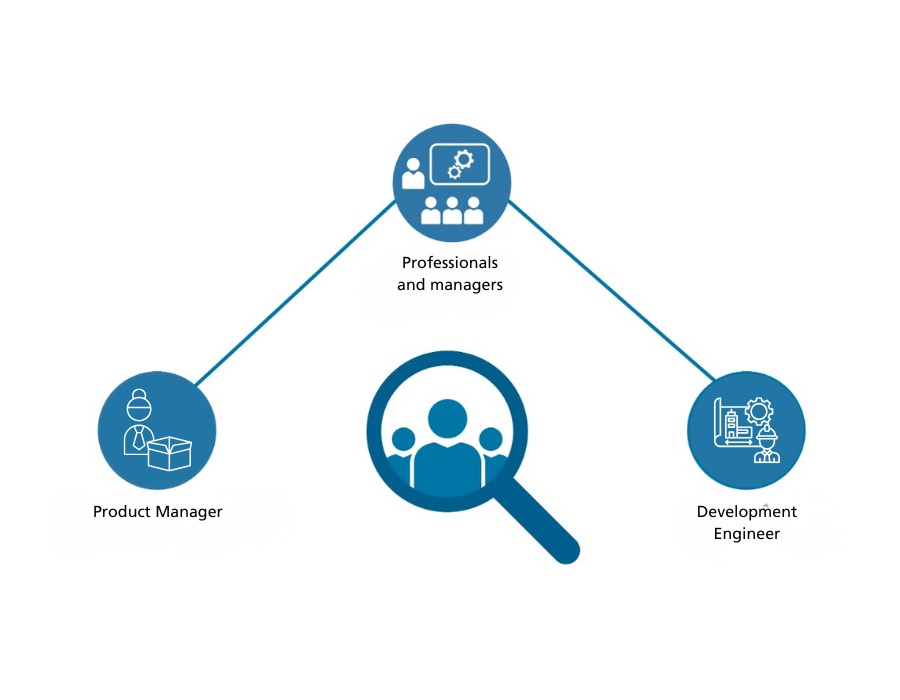
Target group
Your contact

Timm Schulz-Isenbeck, M.Sc.
Mobil: +49 160 99081688
timm.schulz-isenbeck@complexity-academy.com
Experience
- Implementation support for the introduction and implementation of the CTO strategy of an MDAX company.
- Assessment of potential through the introduction of a continuous configuration process and support during the implementation phase.
- Multiple complexity assessments to analyse external and internal variant diversity.
- Market analyses and identification of innovation fields for digital products.
- Development and support of innovation strategy audits.
- Development and implementation of a consortium benchmarking study to identify success factors in AI-supported product development with 21 companies.
- Leading the innovation management focus group.
- Conducting in-house seminars on modularisation and modular design as well as product and portfolio management.
- Developing and conducting a complexity management study focusing on sustainability and product and portfolio management.